The Misunderstood "Wall of Separation": How Prayer Was Removed from Public Schools
A Historical Look at the Real Meaning Behind "Separation of Church and State"
Prayer was removed from public schools on the basis of the supposed "separation between church and state." To understand the true weight — and many would argue the tragedy — of that decision, we must go back in history and examine what our Founding Fathers actually believed on this subject.
Did the Founders Want Christianity Separated from Government?
Our Founding Fathers did not believe in a separation between the government and Christianity. In fact, quite the opposite was true.
In 1853, a group petitioned Congress to separate Christian principles from the federal government — essentially demanding a strict "separation of church and state." Both the Senate and House Judiciary Committees spent nearly a year studying the request.
On March 27, 1854, the House Judiciary Committee issued its report:
"Had the [founding fathers], during the Revolution, a suspicion of any attempt to war against Christianity, that Revolution would have been strangled in its cradle. … At the time of the adoption of the Constitution and its amendments, the universal sentiment was that Christianity should be encouraged, but not any one sect [denomination]."
The report continued:
"In this age, there is no substitute for Christianity… That was the religion of the founders of the republic and they expected it to remain the religion of their descendants."
Two months later, the committee added:
"The great vital and conservative element in our system is the belief of our people in the pure doctrine and the divine truths of the Gospel of Jesus Christ."
The committees concluded that it was impossible — and undesirable — to separate Christian principles from government, because those very principles were what made the nation successful.
What Did the First Amendment Really Mean?
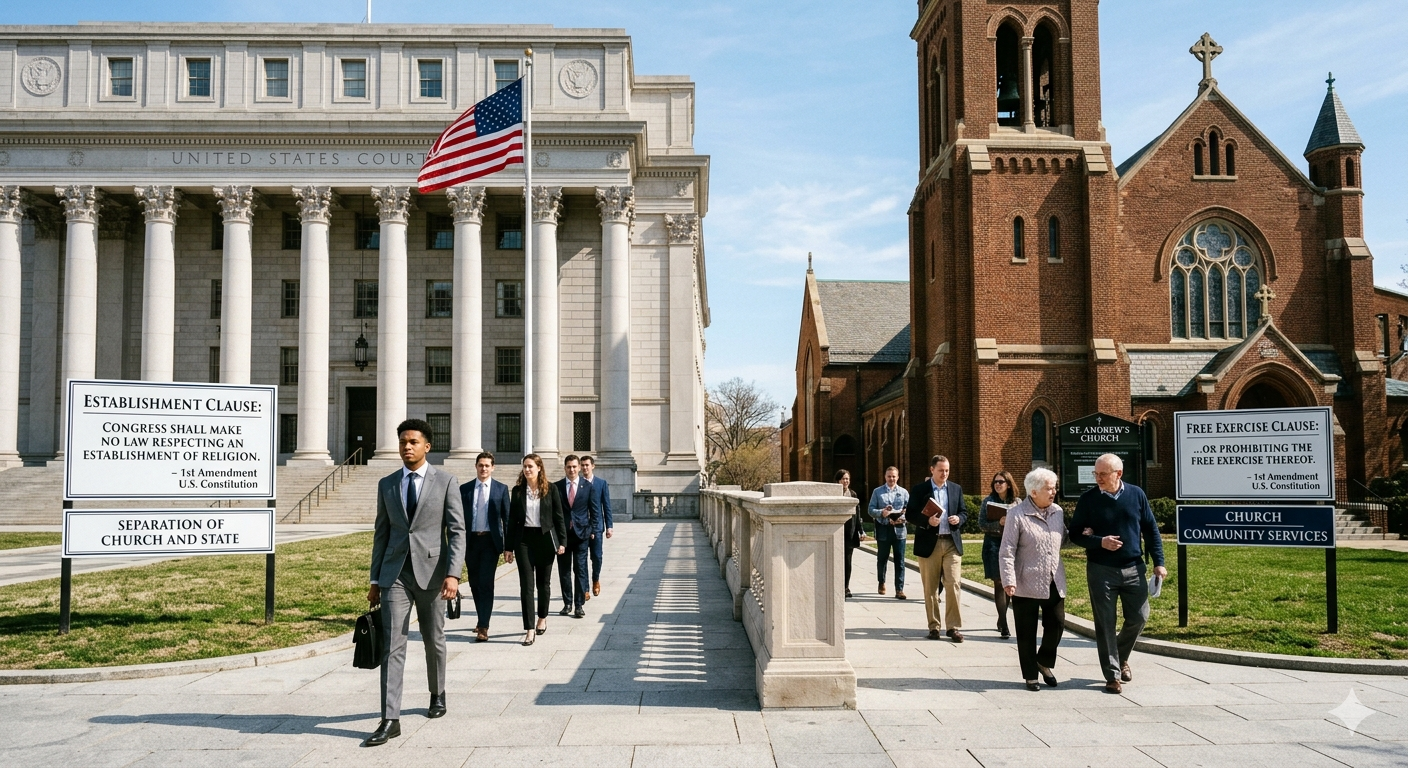
Many people point to the First Amendment, which states:
“Congress shall make no law respecting an establishment of religion, or prohibiting the free exercise thereof.”
The Founders’ intent was never to remove Christianity from public life. Their goal was to prevent any single Christian denomination from gaining control of the federal government and becoming a national church.
The Origin of the Famous Phrase
In 1801, the Danbury Baptist Association wrote to President Thomas Jefferson, alarmed by rumors that the Congregationalist denomination might become the official national church.
On January 2, 1802, Jefferson replied, assuring them that the First Amendment had erected “a wall of separation between church and state.” This is the origin of the famous phrase.
Importantly, Jefferson’s full letter made clear that the “wall” was meant to protect the church from government interference and to prevent any one denomination from dominating. It was never intended to purge Christian principles from public life.
Yet today, only those eight words — “a wall of separation between church and state” — are endlessly repeated, while the context, application, and original intent are ignored.
How the Meaning Was Twisted Over Time
For nearly 150 years, the First Amendment was consistently understood as prohibiting the establishment of a national denomination — not the removal of Christianity from government.
In 1878, the Supreme Court in Reynolds v. United States quoted Jefferson’s letter at length and used it to support the inclusion of Christian values in government policy.
That understanding held until 1947. In Everson v. Board of Education, the Court for the first time quoted only the isolated phrase “a wall of separation” and declared the wall must be kept “high and impregnable” — now using it against Christianity.
As Dr. William James, the father of modern psychology, once observed:
“There is nothing so absurd but that if you repeat it often enough, people will believe it.”
By 1958, a dissenting judge in Baer v. Kolmorgen warned that repeatedly invoking “separation of church and state” would eventually lead people to believe it was actually written in the Constitution.
The Final Blow: Engel v. Vitale (1962)
Despite the warnings, the courts continued down this path. On June 25, 1962, in the landmark case Engel v. Vitale, the Supreme Court struck down voluntary school prayer, citing the misinterpreted “wall of separation.”
For the first time, Christian principles were officially separated from public education — based largely on a phrase taken out of context from a 160-year-old letter.
This decision fundamentally changed American public life. Whether one views it as progress or a profound mistake, understanding the real history behind it is essential.